
Written by Kyle Bekelja, Grape IPM Coordinator, Cornell Integrated Pest Management
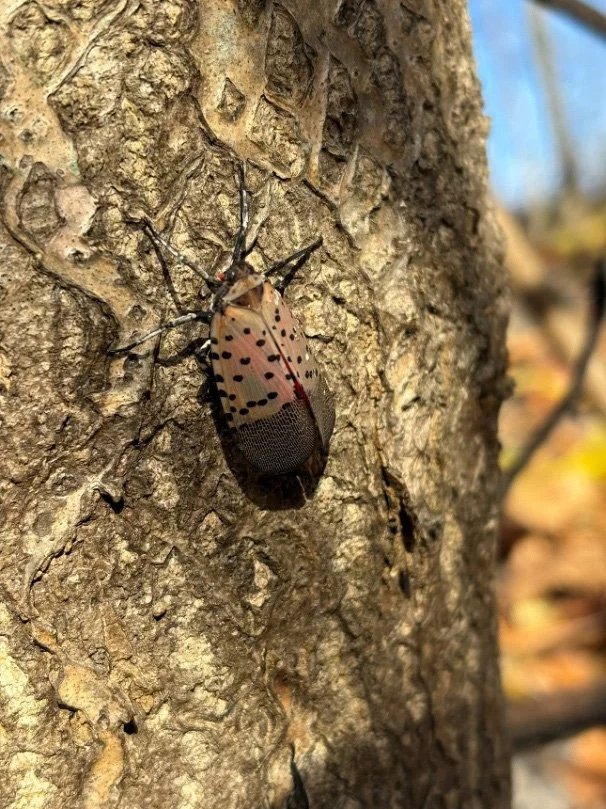
While I don’t expect folks in the Lake Erie region will be applying insecticides for spotted lanternfly (SLF) this year, I wanted to summarize some basic management practices and provide some insecticide efficacy results from last year’s trials.
A quick refresher on management… Unfortunately, this conversation still primarily revolves around insecticides. The best cultural control recommendation we currently have is to maintain healthy vines and limit the number of tree of heaven on your property if you can. Removing tree of heaven won’t eliminate a population once it’s there, but it does make your property slightly less hospitable. You can also save a tree or two as a monitoring tool but be sure they’re males and won’t spread seeds. Action thresholds are not yet well-established, either; however, a good rule of thumb is ~5–20 SLF per vine, depending on how healthy and robust your vines are.
I attached a short list of products that have SLF added to their label, otherwise known as a 2(ee). It’s also available online at this link: https://cals.cornell.edu/integrated-pest-management/outreach-education/whats-bugging-you/spotted-lanternfly/spotted-lanternfly-management#insecticides. The online version is slightly out of date at the moment because, as of yesterday (8/13), we have two new products with 2(ee)s: Leverage 360 and Cryptonyx 360.
A few notes on management…this shouldn’t be relevant to you yet, but I think it’s worth rehashing.
If you’re thinking about spraying and haven’t harvested yet, pay attention to pre-harvest intervals (PHIs) listed on the pesticide label. Importantly, we are still determining how effective these products are at keeping bugs out of harvest bins, but we do know they at least kill lanternflies. The product with the shortest PHI I’ve seen is Mustang Maxx, which can be harvested 1-day after being applied. Leverage 360 and Cryptonyx 360 have a 3-day PHI and are effective against nymphs and adults.
If harvest is close, your SLF population is small, and your vines are healthy, it might be smart to wait until after harvest to spray. Then, you can apply a product with a longer PHI and more staying power. Products with strong residual efficacy include bifenthrin-containing products (e.g., Brigade, Sniper) and fenpropathrin (Danitol). Swagger (bifenthrin + imidacloprid) is another great option.
What about organic options? If you’re interested in organic, botanical, or biologically based chemistries, pyrethrin-containing products are your best bet, and may be adequate if populations are small. Keep in mind that you may need to reapply more frequently. Efficacy data for Beauveria and other biologically based insecticides are still relatively limited, and reports that do exist show either variable efficacy, or have been derived from studies that do not mimic vineyard conditions.
Speaking of product efficacy… Figure 1 includes products trialed last year by Dr. Andres Antolinez, a Cornell entomologist in the Hudson Valley. His experiments were designed to evaluate the residual efficacy of each product – meaning, he tested how effective the product is when the insect encounters dried residues. Because SLF moves between habitats so frequently, evaluating residues likely provides a relatively field-realistic indication of how a product might perform in the vineyard.
Mustang Maxx performed best, not surprisingly. Plinazolin SC 400 is a new mode of action from Syngenta (IRAC Group 30) that is not yet registered for grape. We were hopeful given its efficacy against other pests; however, it was not effective. Grandevo CG (Chromobacterium subsugae strain PRAA4-1T) and Entrust (Spinosad) are organic options, neither of which were effective. Assail and Pest Kote (pyrethrin+PPO) performed surprisingly poorly as well.
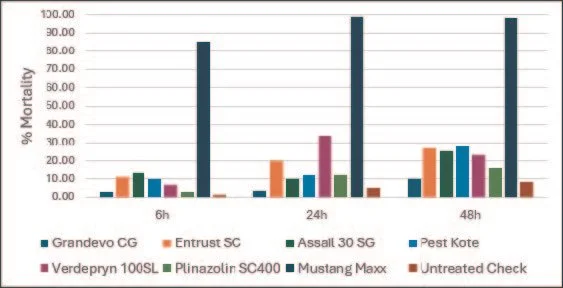
Figure 1. Evaluation of insecticide residues at select time intervals against spotted lanternfly adults in semi-field assays on tree-of-heaven, conducted in the Hudson Valley in 2025 (Antolinez et al., submitted)
This assay highlights an important dichotomy that is rarely discussed regarding SLF management: most insecticides will kill SLF with a direct hit, but because this insect moves so much, the best products yet still require strong residual efficacy. Unfortunately, this lands us back to where we probably should not be surprised to find ourselves: relying largely on pyrethroids and some neonicotinoids. We’re working on better solutions, but this is where we are for now…
To summarize, insecticides with strong residual activity remain our most reliable tools for managing SLF in vineyards for now. While this pest remains on the near horizon, continue scouting and reporting, and keep your vines healthy. In the meantime, research and outreach efforts across New York are working toward more effective and sustainable long-term solutions – more on those projects soon! Please reach out with questions or comments.
Contact Information:
Kyle Bekelja
kmb399@cornell.edu
Phone: 315-787-2205