
Written by Jessica Clippinger
As harvest approaches, deciding whether another fungicide application is needed can be challenging, especially since every farm is different.
While clusters have developed ontogenic resistance to most diseases by this point in the season, leaves are often still susceptible. Disease pressure, variety susceptibility, crop load, weather, cost, and fungicide resistance all need to be considered.
More sprays are not always better. The benefit achieved from healthier leaves must be weighed against the cost of an additional spray. When disease pressure is moderate to low, aggressive early season cultural practices and possibly biological products may help reduce the need for additional conventional fungicides. When disease is already established, however, choosing an effective product—and avoiding products to which resistance has developed—is critical.
The following are some considerations for three important late-season diseases.
Downy Mildew:
Don’t Let It Defoliate Your Vines
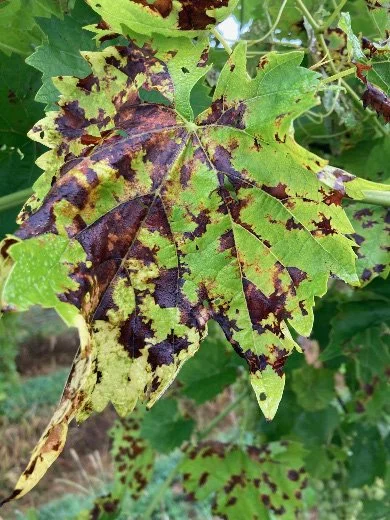
Downy Mildew on the top of a grape leaf
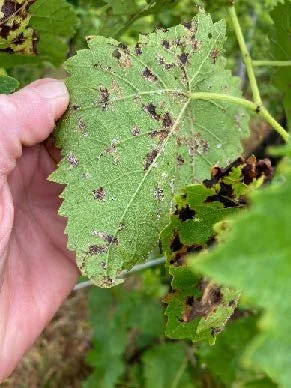
Downy Mildew on the underside of a grape leaf
Downy mildew has been a problem in local vineyards, particularly on vinifera, hybrids, and Niagara and is likely exasperated due to the recent heavy rains. Although berries of susceptible varieties become resistant to infection about 3–5 weeks after bloom, leaves remain susceptible throughout the season. Don’t neglect scouting for downy mildew as it can help you avoid a blowup of disease during ripening.
When disease pressure is high, downy mildew can not only reduce brix accumulation but can cause serious defoliation. This can reduce vine cold hardiness and increase the amount of inoculum available for the following growing season.
When downy mildew is present at moderate to high levels, two or three copper applications (on tolerant varieties*) approximately 10 days apart can help reduce infection. Note that copper applied under slow drying conditions such as cool or very high humidity may cause phytotoxic plant injury even to tolerant varieties including Concord. The addition of lime to increase pH helps reduce the chance of phytotoxicity, but cannot be used with Captan, Imidan, or Sevin.
This is also a situation where fungicide resistance deserves particular attention. Research conducted by Bryan Hed and I in 2023 and 2024 found high levels of downy mildew resistance in the Lake Erie region to:
Strobilurins — FRAC 11
Carboxylic acid amides — FRAC 40
Phosphorous acid products
These fungicides should therefore NOT be relied upon alone for downy mildew control.
Multi-site products such as mancozeb, captan (do not apply within ten days of applying stylet oil), and copper (on tolerant varieties*) are less prone to resistance development. Remember that mancozeb has a 66-day preharvest interval, while copper and other protectants can be washed off by heavy rainfall.
When disease pressure is light to moderate, products such as Ridomil (FRAC 4), Ranman (FRAC 21), and Zampro (FRAC 45/40) can provide good to excellent control. Rotate FRAC groups and do not use these single-site products more than twice per season.
If disease pressure is low, biologicals such as Howler EVO or Theia could be included within a conventional fungicide rotation.
*Refer to the NY and PA Pest Management Guidelines for Grapes Table 3.1.2 for varietal copper sensitivity.
Powdery Mildew:
Protecting the Leaves
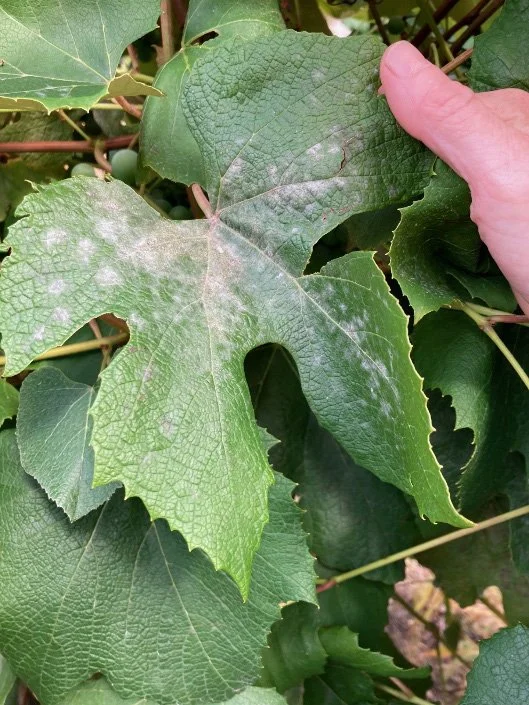
Powdery Mildew on the top of a grape leaf
Powdery mildew susceptibility is different on fruit and foliage late in the season. Concord fruit becomes immune approximately two weeks after fruit set, while vinifera berries become resistant about 3–4 weeks after bloom. Leaves remain susceptible throughout the season.
For growers carrying a large crop, maintaining healthy foliage may help ensure minimum Brix levels are achieved and reduce the amount of overwintering inoculum.
When temperatures are in the 70s and 80s with high humidity, infection periods can occur almost daily. Whether another fungicide application is warranted should depend on crop size, disease pressure, variety susceptibility, and cost of fungicides.
Effective options include Endura, Gatten, and Cevya. Sulfur (on tolerant varieties*) can be an effective tank-mix partner for vinifera but is Clippingerphytotoxic to Concord and other native cultivars and red hybrids. It should also not be applied within two weeks of an oil spray or 4-6 weeks before harvest for red wine grapes. Nutrol provides moderate post-infection control and is another tank-mix option.
Strobilurin (FRAC 11) resistance is confirmed, so these products are expected to provide little to no control of powdery mildew. There is also possible resistance to Vivando, so it is not currently recommended. Trials conducted with Bryan Hed have generally shown newer fungicides such as Endura, Cevya, and Gatten performing better than older products such as Torino, Quintec, and Tebuzol.
When disease pressure is low and varieties are not highly susceptible, Harvestmore and biological products such as Howler EVO, Theia, Ecoswing, and Stargus could be incorporated into a powdery mildew rotation.
*Refer to the NY and PA Pest Management Guidelines for Grapes Table 3.1.2 for varietal sulfur sensitivity.
Botrytis:
Is a Veraison or Pre-Harvest Spray Worth It?
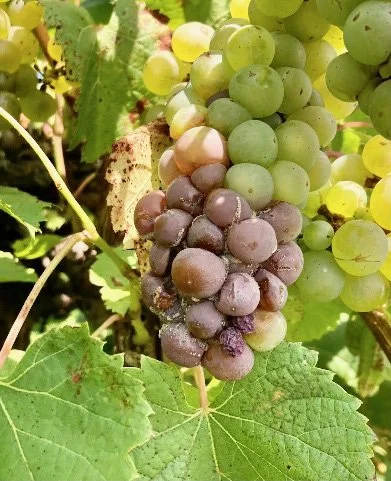
Botrytis on a Vignole berry cluster (bottom portion of the cluster)
With the recent high rainfall amounts, splitting of berries can provide ideal conditions for Botrytis to infect and spread through tight clusters. Botrytis infections are often difficult to see until veraison or shortly before harvest. Infections that occur around bloom or later can remain latent until conditions become favorable, particularly during long wetting periods with moderate temperatures. If conditions are right Botrytis can quickly rot an entire tightly packed cluster.
Start with the canopy. Practices that loosen clusters and improve air movement and spray penetration can greatly reduce Botrytis development. Leaf removal is most effective shortly after fruit set. For very susceptible varieties with tight clusters, a second round of leaf removal during midseason may provide additional benefit. Both powdery mildew and insect damage can contribute to Botrytis infection and should be properly managed throughout the season.
A veraison or pre-harvest fungicide application may be appropriate for susceptible, tight-clustered varieties before a stretch of wet weather. However, all seven FRAC groups labeled for Botrytis control are prone to resistance development. Rotate among FRAC groups and avoid using the same FRAC group more than twice per season (see table right with PHI listed).
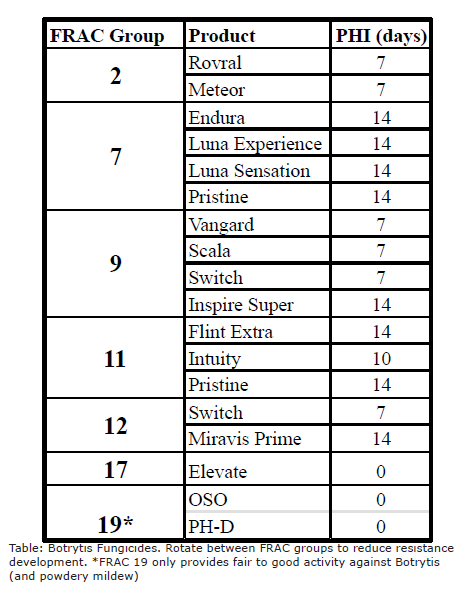
For specific questions regarding disease and fungicide sprays check the most recent New York and Pennsylvania Pest Management Guidelines for Grapes or contact your local extension personnel.