
written by Andrew Holden
As of last month, I am a Certified Farm Succession Coordinator. In this article, I explain the process of the training I attended, what a coordinator’s role is, and how I think it may be useful for growers in our region. Please read below to learn more and contact me if you have any interest in participating in farm succession conversations in the future:
Last April, I attended the International Farm Transition Network’s (IFTN) Certified Farm Succession Coordinator Training in Wooster, Ohio. This 20-hour training featured insight into the barriers to farm succession, strategies for working with families, facilitation tools to guide the process, and opportunities to consider real-life examples of farm transfer conflicts. To become a certified coordinator by the IFTN I had to then pass an exam after completing the training. I have since passed and become certified, and plan to use this new certification to assist growers in our Lake Erie grape belt.
In my extension role as a business management educator, I provide research-based information on a variety of topics for growers to use in their operation and decision-making process. Additionally, I try to keep growers up to date with any relevant management news, grants, programs, or opportunities. By becoming certified as a Farm Succession Coordinator, I am able to provide another service which I believe is vital for our region and industry. Farm Succession Coordinators serve as a neutral third party to help farm families arrive at agreeable solutions by guiding them through the planning process.
In working with farm families, the coordinator’s role is to help the family:
Determine where the farm is now;
Figure out where they want to be; and
Create a road map or game plan to help them get there.
The training I completed equipped me with techniques and tools to help families arrive at an agreeable plan and help set them up for succession success. With a national network of farm transition professionals, I now have access to multiple universities, along with guides and workbooks that growers can use to navigate what one of our instructors, Joy Kirkpatrick, coined “The Messy Middle”. I am including an article of hers at the end of this one that talks about this topic. If you and your family need assistance navigating the difficult process of farm transition, please reach out to me at any time.
Unfortunately, many farm succession decisions get made out of necessity. It is never too early to plan for the future of your farm. Perusing open conversations about farm goals and ideas for the future with family members will help reduce confusion or disagreements that could arise due to miscommunication or assumptions. These conversations can be difficult; I have firsthand experience and can attest to that. As a coordinator, I hope to ease tensions that come from planning for succession and help farm families get to a place where they can be excited about, and have a plan they look forward to executing.
The messy middle of farm succession planning
Written by Joy Kirkpatrick
How would you describe your attitude or emotions to the words “farm succession planning”? Excited, hopeful, motivated? Or maybe the words that come to mind are apprehensive, stressed, or conflicted. Perhaps at different times all these words can be used to describe your attitude about farm succession. Transferring the assets and management of the farm business is what I call “Big Change”. It can be exciting to think about the business continuing to the next generation and even good things are stressful when there is Big Change connected to it.
Big Change
Big Change like farm succession is not going to happen overnight and it will involve making space for new goals, visions, and ideas. I’ve worked with farm and family members when they have first recognized the need to talk about succession. They are motivated and excited to start– and maybe they are even a little bit relieved that they are starting the conversation – because it may have felt like succession planning was “the elephant in the room”.
Then the farm members get to that place where they face some tension points – it might be the financial capacity of the business, or the balance of inheritance needs to be discussed. Or it might be that the successor generation wants to bring their management ideas and opinions to the table. This is where farm members start feeling a bit unsettled. They can’t keep moving forward on a linear path to an immediate decision. But now the elephant is not only in the room, but it is asking for a seat at the table!
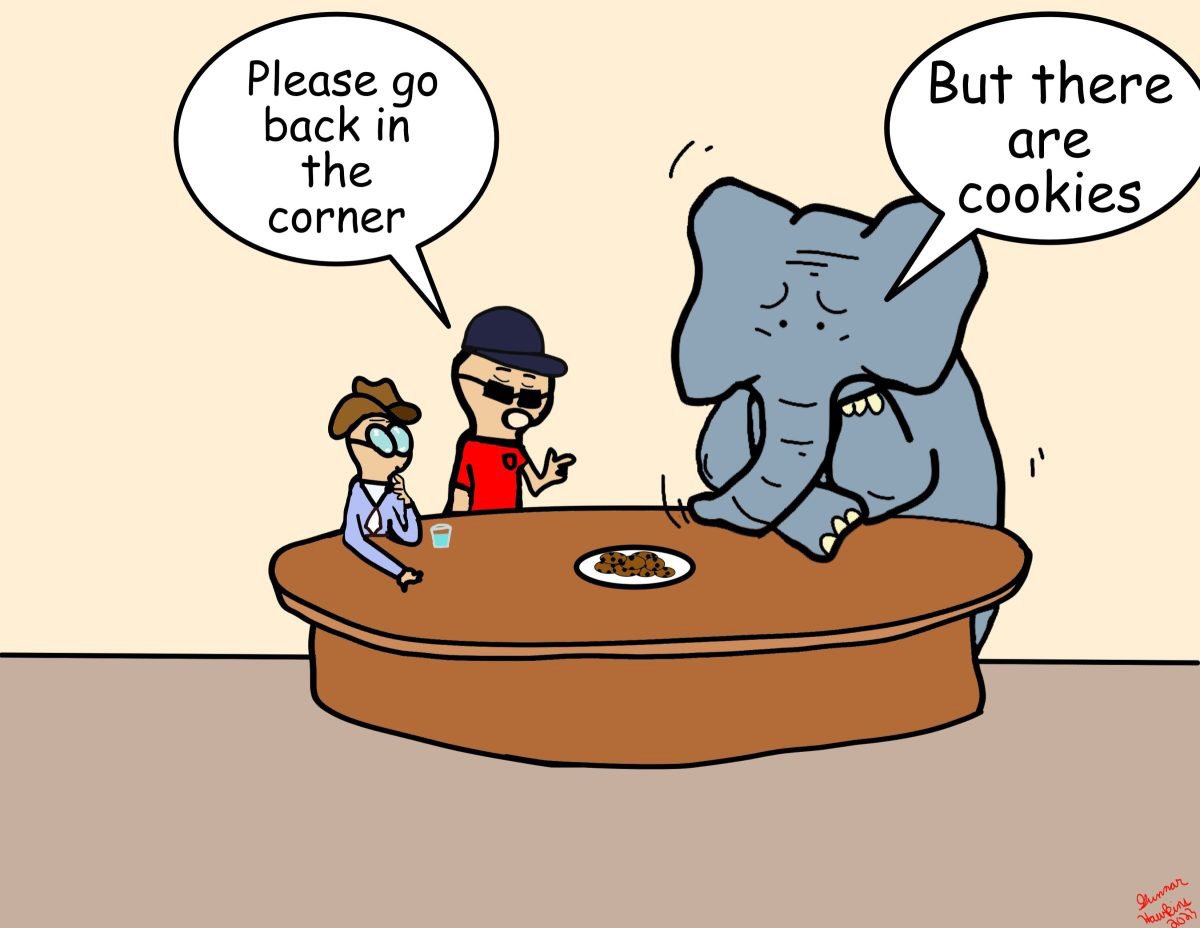
Illustration by: Gunnar Hawkins
The Messy Middle or Groan Zone
Feeling unsettled and perhaps not having a clear direction of what to do next brings us to the Messy Middle. The Messy Middle is a term I first learned about from a Brené Brown podcast, Brené on Day 2, as the term for the middle of any experience where things get rocky, or we hit a wall. She compares it to a three-day conference. Day One is all excitement about new ideas, concepts, and new possibilities. Day Two is the “oh, crap, how is this going to work in reality” day. But we need Day Two to get to Day Three. When thinking about this in regards to group decision-making, Sam Kaner and his colleagues call it the “Groan Zone” in their book, Facilitator’s Guide to Participatory Decision-Making. This is the time after differing ideas and opinions are voiced and there isn’t a clear path on how to take the best pieces of each idea and synthesize it into a decision or a plan.
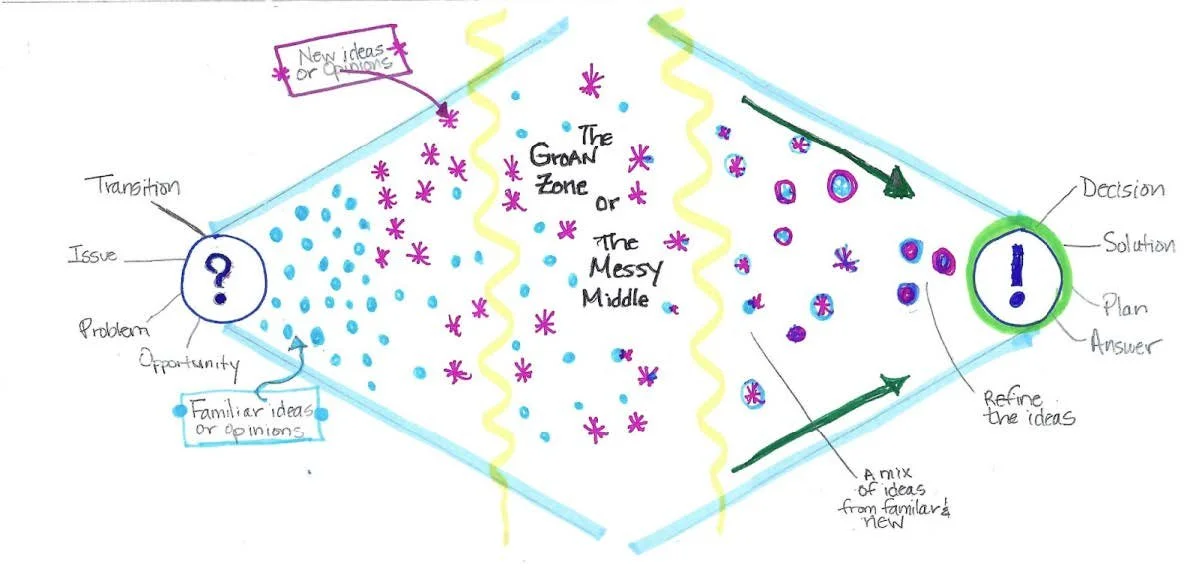

On the left side of the image is where the issue, problem, perhaps succession discussion, or opportunity comes to light. The blue dots are familiar ideas or opinions. And maybe you have others who are now a part of the discussion, and they are bringing new ideas and opinions to the table as well. In this drawing these new ideas are the pink asterisks. These differing ideas lead the group into what Kaner calls the “Groan Zone” and Brown calls “The Messy Middle”.
The Messy Middle sounds like something nobody wants to go through, right? This is the point where farms might stall-out and perhaps drop the discussion.
It’s where you may want to stay in your comfort zone and continue making decisions and managing the farm in the familiar patterns of the past. I want to challenge you to stick with the process and sit with the uncomfortableness.
A facilitator can help
You may need a facilitator or someone outside the business and family to help you move through the Messy Middle – which is where deeper conversations and mutual understanding of the needs of the farm and family members can be discovered. Mutual understanding can lead you out of the
Messy Middle into the right side of the drawing, where the best of all the ideas and opinions are examined to decide which one or combination of them will best address the issue or stressor you’re trying to address – and when that’s done, the fun part of planning and acting on decisions can happen.
But if you try to avoid the Messy Middle, you risk leaving great ideas on the table unexamined and you risk leaving key people out of the decision-making process. Farms that skip over this part of the decision-making process may be able to move forward for a while. However, ignoring it won’t make the issue go away. In succession planning, skipping over it may mean that you’ve made promises or entered a business arrangement that you now wished you hadn’t. Skipping the Messy Middle may drop you into a bigger and more expensive mess you have to unwind.
The main points are when you get to the Messy Middle:
Don’t panic! And now you have a name for that unsettled feeling so you can acknowledge it and dig in a little deeper.
Resist the urge to go back to the left side and pick an idea because that feels comfortable.
Resist the urge to skip over the Messy Middle – and think you’re fast-forwarding the process – you need the Messy Middle!
While the Messy Middle and the Groan Zone have slightly different contexts, they both emphasize the importance of embracing discomfort and uncertainty as a necessary part of any process of change or decision-making. Both Brown and Kaner argue that by acknowledging and working through these challenging phases, we can ultimately become more resilient and better equipped to handle the challenges that come our way.
The Cultivating Your Farm’s Future: A workbook for farm succession planning in Wisconsin can help farm members start conversations around some of the more common things that bring them to the Messy Middle.